
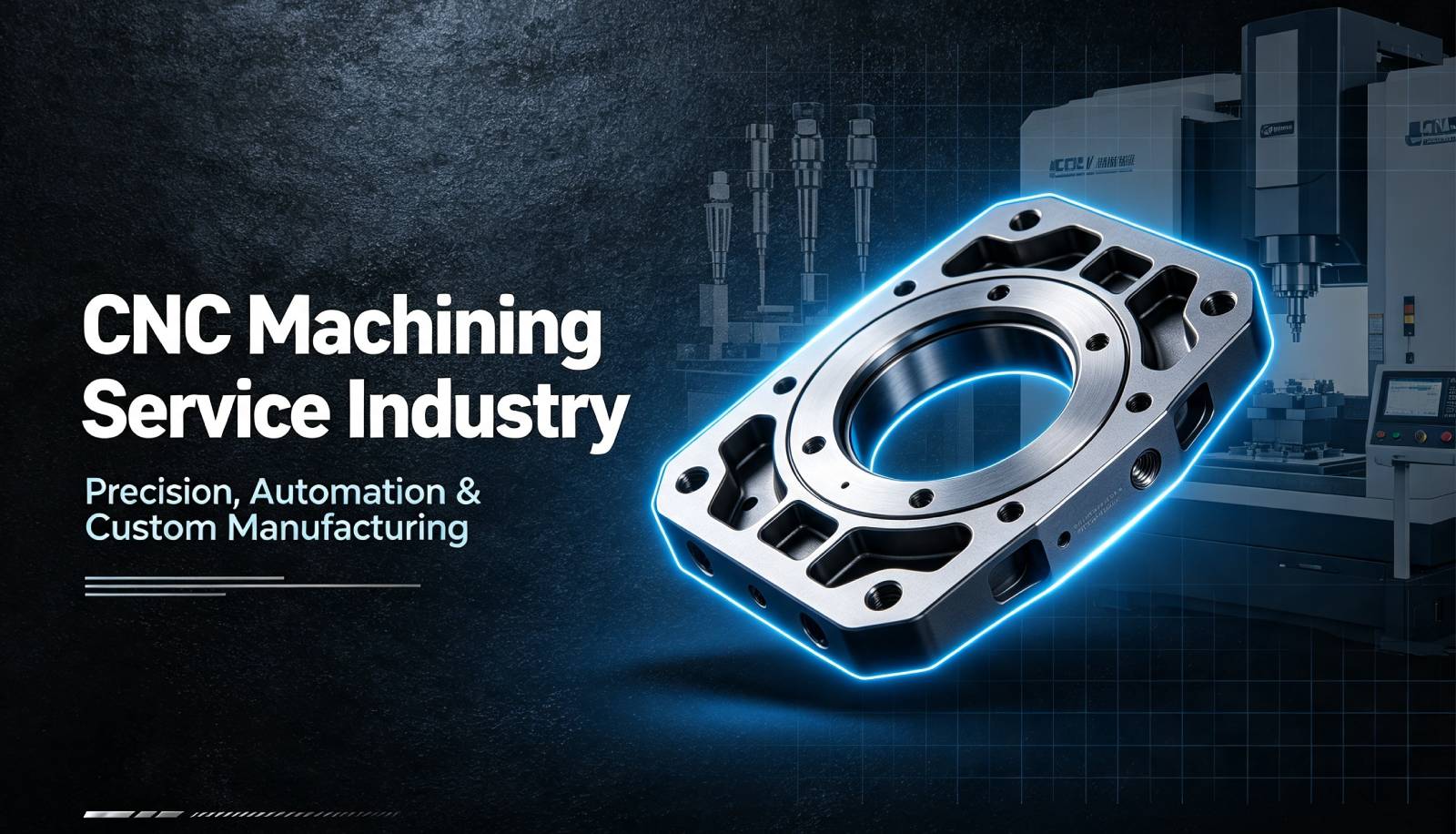
CNC precision machining is a fundamental manufacturing process. It is widely used in automotive, new energy, medical devices, aerospace, industrial automation, precision electronics and many other industries. Global manufacturing is undergoing continuous upgrading and supply chain reform. Meanwhile, customized low-volume manufacturing demands keep growing, bringing new changes to the CNC machining service industry. For global buyers, engineering teams and manufacturers, a clear understanding of industry status, market features and future trends helps them select reliable CNC machining partners and meet their needs for prototyping, custom production and batch manufacturing.
Current Development Status of the CNC Machining Service Industry
Currently, the global CNC machining service industry maintains stable growth. The market division is clearer, and a two-tier structure has gradually formed. High-end manufacturers keep upgrading their production capacity. They adopt 5-axis machining centers, high-precision testing equipment and automated production systems. These professional factories focus on high-precision, high-difficulty and high-value custom parts. They can meet strict tolerance and quality standards for new energy, medical and aerospace applications.
In contrast, the mid-to-low-end market faces severe homogeneous competition. Most small workshops only use standard 3-axis machines and focus on low-cost batch processing of common metal and plastic parts. They compete mainly by low pricing. However, most of these small factories lack complete quality control systems, standardized processing procedures and stable delivery capabilities. These problems are the most common risks for overseas buyers in supplier cooperation.
China has become the core production base for global CNC machining services. The Yangtze River Delta and Pearl River Delta have formed a complete industrial chain. The full-service system covers raw material supply, tooling support, surface treatment, heat treatment and precision inspection. Complete industrial support enables Chinese CNC factories to offer fast delivery, reasonable costs and flexible customization. This is the key reason why global clients prefer Chinese custom machining services.
In addition, CNC machining application scenarios continue to expand. Conventional aluminum and steel machining have become basic services. The demand for hard-to-machine materials, including titanium alloy, PEEK, carbon fiber and precision ceramic, increases year by year. This drives CNC machining service providers to optimize processing techniques and upgrade equipment to support diversified and high-precision manufacturing requirements.
Overall Pattern and Demand Characteristics of the Global CNC Machining Service Market
The global outsourced CNC machining market continues to grow steadily with strong market resilience. Compared with traditional injection molding, CNC machining requires no molds, offers high flexibility and short lead time. It perfectly matches the modern manufacturing model of small batches, multiple iterations and fast product updates. Therefore, CNC outsourcing continues to gain importance in the global supply chain.
The automotive and new energy industries are the largest downstream markets for CNC machining services, including battery structural parts, motor components and automotive chassis parts. Other major high-value fields include medical devices, aerospace, industrial robots, automation equipment and precision electronics. These industries require strict precision standards, stable processing quality, qualified materials and complete inspection reports, creating high entry barriers for ordinary machining workshops.
Different regions show distinct purchasing characteristics. North American clients prefer small-batch prototyping and customized parts. They value precision and delivery speed with flexible budget tolerance. European buyers focus heavily on product quality, production compliance and standardized quality inspection, and tend to build long-term cooperation with formal and scalable factories. Manufacturing in Asia and Southeast Asia develops rapidly, but local high-precision machining capacity is insufficient. Most complex and high-tolerance parts still rely on CNC machining suppliers from China.
The industry purchasing model has changed greatly. Traditional offline exhibitions and middleman cooperation are declining. Today, most overseas purchasing engineers search for reliable CNC machining suppliers through search engines such as Google. They evaluate factory capabilities, review machining cases and confirm service scopes through official websites. Online consultation, drawing-based quotation and remote production tracking have become the mainstream cooperation mode in CNC foreign trade business.
Core Future Development Trends of the CNC Machining Service Industry
Popularization of 5-axis Precision Machining to Become the Core Competitiveness of the Industry
In the past, 5-axis machining was only used in high-end fields such as aerospace. In the future, 5-axis machining will become a standard industrial capability. It supports one-time clamping and multi-angle forming. It effectively reduces dimensional errors caused by repeated clamping and solves machining difficulties for complex curved surfaces, special-shaped structures and high-precision hole parts. Mature 5-axis machining capability will become a key standard to distinguish high-end precision factories from ordinary workshops.
Intelligent and Automated Production Replaces Traditional Manual Machining
Global manufacturing faces widespread problems of skilled labor shortages and rising labor costs. This drives the CNC machining industry toward intelligence and unmanned production. Technologies such as AI programming, automatic tool wear monitoring, automatic loading and unloading, and intelligent temperature control are widely applied. These technologies reduce manual errors, improve product yield and shorten delivery cycles. Intelligent production lines will become the standard configuration of high-quality CNC factories and completely upgrade traditional manual processing modes.
Flexible Custom Production Becomes the Mainstream Market Demand
To avoid inventory risks and accelerate product iteration, modern manufacturers gradually abandon large-batch fixed production and adopt the mode of small-batch prototyping, on-demand mass production and fast upgrading. CNC machining supports zero-mold production, single-piece manufacturing and flexible small-batch orders, which perfectly fits current market demands. In the future, the proportion of low-volume customization, rapid prototyping and personalized precision parts will keep rising, and flexible manufacturing will become a core advantage of CNC service providers.
One-stop Comprehensive Services Form Core Competitive Barriers
Single mechanical machining services can no longer meet overseas clients’ one-stop purchasing needs. Factories that provide full-process services including CNC machining, surface treatment, heat treatment, precision inspection and assembly will gain greater market advantages. Supporting processes such as anodizing, sandblasting, electroplating, wire drawing and anti-corrosion treatment, together with value-added services like CMM inspection, dimension reports and material certification, greatly reduce customers’ communication and procurement costs and form core competitiveness for foreign-trade CNC enterprises.
In-depth Segment Development with the High-end Precision Track Keeping Growing Popular
As market competition intensifies, extensive and all-inclusive operation modes are gradually eliminated. The industry is moving toward vertical segmentation and professional refinement. More CNC factories focus on segmented fields such as new energy, medical equipment, aerospace and robotics. They accumulate professional techniques, industry experience and compliance qualifications to solve targeted precision machining problems. Vertical specialization has become the best way for small and medium CNC factories to avoid low-price competition and achieve sustainable development.
Industry Summary
Overall, the global CNC machining service industry is in a stable upward cycle. Although the low-end market faces fierce price competition, high-end precision customization, segmented industrial supporting and one-stop flexible manufacturing still bring huge market potential. The industry will continue to develop toward higher precision, intelligence, flexibility, one-stop service and professional segmentation. For global manufacturing buyers, choosing professional CNC suppliers with standardized quality control, intelligent production capacity and full-process supporting services can effectively improve R&D efficiency, stabilize product quality, reduce procurement costs and build long-term reliable supply chain cooperation.